
Construction projects often start with clear goals and enthusiasm, but many end in conflict. Even with modern technology and project systems, disputes are still very common in construction. From my experience as a quantity surveyor and former contract manager, disputes don’t just happen, they show deeper problems in how projects are set up and run.
The Statistical Reality: How Bad Is the Problem?
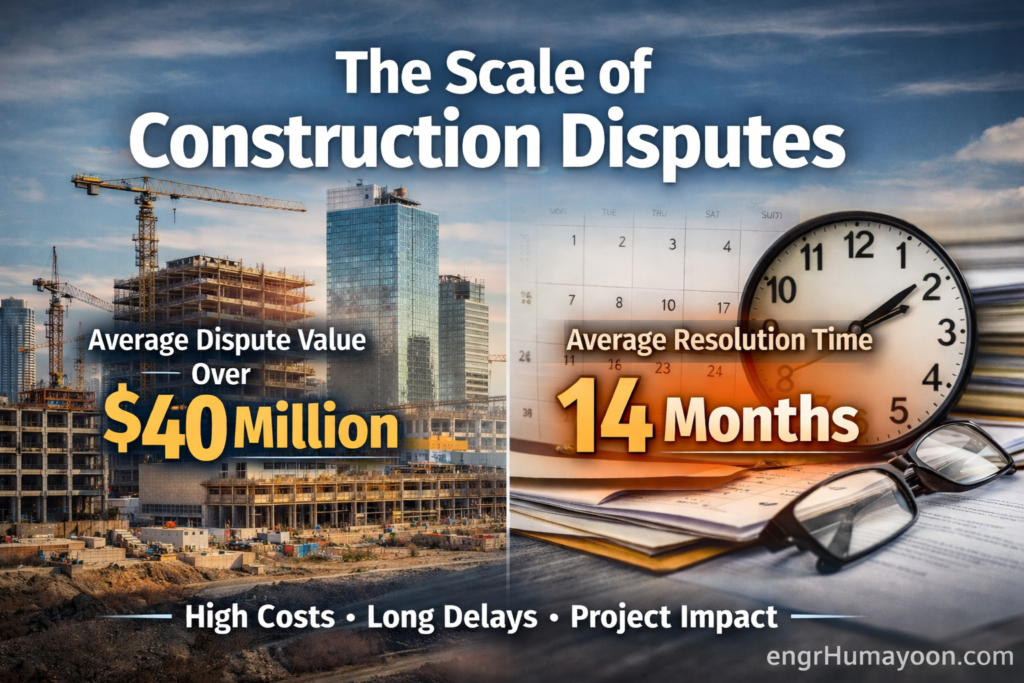
Before diving into the mechanics of why disputes occur, let me share some alarming statistics that underscore the magnitude of this challenge. According to research published by Arcadis in their Global Construction Disputes Report, the average value of construction disputes globally has consistently remained above $40 million over recent years, with some regional variations showing even higher figures. The average length of dispute resolution stretches to approximately 14 months, representing a significant drain on resources, management attention, and project momentum.
A study conducted by HKA’s CRUX Insight Report revealed that construction projects experience an average delay of 20.5% against their original schedule, with disputes being a primary contributing factor. The research indicates that approximately 70% of all construction projects face some form of contractual claim or dispute during their lifecycle. When I reflect on my own experience managing contracts, this figure doesn’t surprise me, it actually feels conservative.
The financial impact extends beyond direct dispute costs. Research from the Construction Industry Institute demonstrates that disputes consume approximately 3-7% of total project costs when considering legal fees, expert witnesses, management time, and opportunity costs. For a $100 million project, this translates to $3-7 million potentially lost to conflict resolution rather than value creation. In my role as a quantity surveyor, I’ve seen how these hidden costs erode project margins and damage long-term business relationships.
Perhaps most concerning is data from the Royal Institution of Chartered Surveyors, which indicates that approximately 90% of construction disputes arise from issues that could have been prevented through better project management, clearer communication, and more robust contractual documentation. This statistic has profoundly influenced how I approach my work, it suggests that the problem isn’t inherent to construction itself, but rather to how we organize and execute projects.
Research by McKinsey & Company reveals that large construction projects typically take 20% longer to complete than scheduled and run up to 80% over budget. While not all delays and cost overruns result in formal disputes, they create the conditions where conflicts flourish. In my experience, every variation order, every delay notice, and every cost escalation becomes a potential flashpoint for disagreement.
Understanding the Three-Party System: Where Complexity Breeds Conflict
The traditional construction delivery model involves three primary stakeholders: the client (or owner), the consultant (typically architects, engineers, and project managers), and the contractor (including subcontractors and suppliers). This triangular relationship, while logical in theory, creates multiple interfaces where miscommunication, misaligned incentives, and conflicting interests can emerge.
The Client: Expectations, Constraints, and Competing Priorities
From my perspective working across the client-consultant-contractor spectrum, I’ve observed that clients often enter construction projects with inherently contradictory expectations. They want premium quality, aggressive schedules, and minimal costs, the infamous “fast, cheap, good: pick two” dilemma that plagues our industry.
Clients frequently lack technical construction knowledge, which isn’t a criticism but rather an acknowledgment of reality. A property developer, corporate facilities manager, or government procurement officer may be sophisticated in their domain but unfamiliar with construction complexities. This knowledge gap creates several problems. First, clients may establish unrealistic expectations about what’s achievable within their budget and timeline. I’ve reviewed countless briefing documents where the client’s aspirations clearly exceeded their financial provisions by 30-40%, setting up inevitable disappointment.
Second, clients often struggle to make timely decisions. In my contract management role, I tracked decision-making delays as a key risk factor. When a client takes three weeks to approve a material selection that was needed in five days, the entire project schedule compresses, placing impossible pressure on contractors and creating fertile ground for disputes about delays and acceleration costs.
Third, clients frequently change their requirements mid-project. Scope creep is perhaps the single most common dispute trigger I’ve encountered. What begins as a “small change” cascades through design, procurement, and construction, generating variation claims, delay arguments, and finger-pointing about who should bear the costs.
The client also controls project funding, and cash flow problems represent another major dispute source. I’ve managed situations where contractors completed work satisfactorily but waited 90+ days for payment because the client’s financing arrangements fell through. These payment disputes can quickly escalate and poison the entire project relationship.
The Consultant: Caught Between Competing Loyalties

Consultantsm architects, engineers, quantity surveyors, and project managers, occupy a uniquely difficult position. They’re typically engaged by the client and owe them professional duties, yet they must maintain working relationships with contractors and make objective assessments that sometimes favor the contractor’s position over the client’s interests.
This dual role creates inherent tensions. When certifying payments or assessing extension of time claims, they must balance their duty to protect the client’s interests with their professional obligation to be fair and evidence-based. Contractors sometimes view consultants as merely the client’s representatives, while clients occasionally feel their consultants aren’t sufficiently advocating for them.
Consultants face dispute risks from multiple directions. Clients may claim we provided negligent design, inadequate specifications, or poor contract administration. Contractors may argue we’ve been unfair in our assessments, delayed decisions, or issued ambiguous instructions. When disputes arise, consultants often find themselves named as co-defendants or blamed by both other parties.
From my experience, several consultant-related issues frequently trigger disputes. Incomplete or poorly coordinated design documentation leads to requests for information, variations, and claims. I’ve worked on projects where architectural, structural, and MEP drawings contained hundreds of clashes and inconsistencies, forcing contractors to seek clarification constantly and creating delay and disruption.
Inadequate site investigation and unforeseen ground conditions represent another major dispute source, particularly in civil engineering projects. When consultants’ geotechnical reports don’t accurately characterize subsurface conditions, contractors encounter unexpected rock, contamination, or groundwater, triggering substantial claims.
Poor contract administration, delayed responses to contractor queries, inconsistent application of contract terms, inadequate record-keeping creates ambiguity that lawyers exploit during disputes.
The Contractor: Bearing Risk and Battling Margins
Contractors operate in an intensely competitive, low-margin environment where winning bids often requires aggressive pricing. Research indicates that contractors’ net profit margins typically range from 2-5%, leaving minimal buffer for unexpected costs or events. This economic reality fundamentally shapes contractor behavior and dispute dynamics.
During tender periods, contractors face immense pressure to submit competitive prices. This leads to several problematic practices I’ve observed repeatedly. First, contractors may “buy the job” by submitting below-cost bids, planning to recover through claims and variations. Second, they may inadequately price risks, hoping conditions will be favorable. Third, they may make optimistic assumptions about productivity, weather, or site conditions.
Once awarded the project, contractors must deliver against tight margins while managing numerous risks: labor productivity, material price fluctuations, weather delays, subcontractor performance, design coordination issues, and client changes. Each risk that materializes erodes profit margins, creating financial pressure that makes contractors more likely to pursue claims aggressively.
Contractors also manage complex supply chains involving dozens or hundreds of subcontractors and suppliers. These relationships create additional dispute vectors. When a specialist subcontractor delays or performs defectively, the main contractor faces potential liability to the client while simultaneously pursuing claims against the subcontractor. These “back-to-back” disputes complicate resolution significantly.
Cash flow challenges particularly affect contractors. Construction payment structures monthly valuations, retention holdbacks, final account settlements mean contractors must finance work for extended periods. Late payments compound this problem. I’ve seen contractors forced to slow work or deploy fewer resources because clients haven’t paid certified amounts, triggering disputes about progress and delays.
The contractor’s position at the “coal face” means they encounter every project problem first. When design issues emerge, contractors must stop work, seek clarification, and potentially demolish and rebuild. When site conditions differ from expectations, contractors bear immediate cost impacts. This reality makes contractors acutely sensitive to potential claims and often defensive in their interactions with clients and consultants.
The Perfect Storm: How System Dynamics Create Disputes
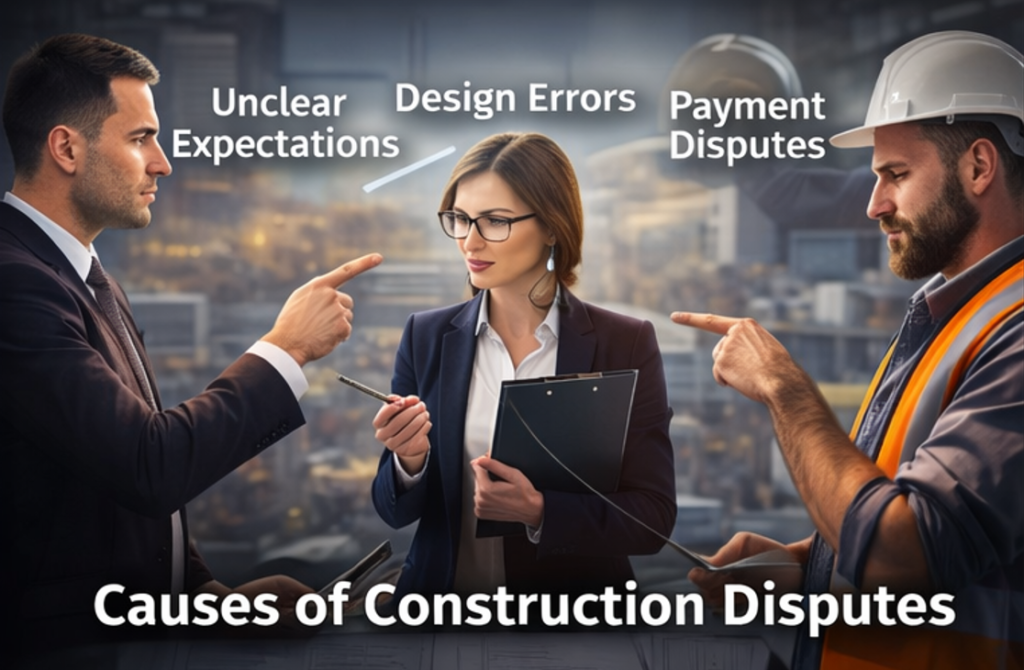
Understanding each stakeholder’s perspective helps explain why disputes emerge, but the real problem lies in how these three parties interact within adversarial contractual frameworks and misaligned incentive structures.
Traditional construction contracts, particularly in common law jurisdictions, are fundamentally adversarial. They allocate risks, define obligations, and establish remedies for non-performance. While necessary, this legalistic framework encourages parties to protect their positions, document defensively, and view problems through a claims lens rather than collaboratively seeking solutions.
The economic incentives are frequently misaligned. Clients want to minimize costs and maximize value, creating pressure to constrain budgets and resist variations. Contractors need to maximize revenue and protect margins, encouraging them to pursue claims and variations. Consultants, often paid fixed or percentage-based fees, may lack strong incentives to invest the time needed for thorough problem-solving.
Information asymmetries compound these challenges. Contractors possess superior knowledge about means, methods, and actual costs, while clients control broader project objectives and financial constraints. Consultants theoretically bridge this gap but face limitations in both directions. These knowledge imbalances create suspicion and defensive behavior.
The sequential nature of construction is design, then procurement, then construction means errors and omissions in early phases manifest as problems later when they’re more costly to resolve and when multiple parties have already committed resources based on flawed information. The “throw it over the wall” mentality between design and construction phases creates a fertile environment for blame-shifting.
Time pressure intensifies everything. Clients typically want projects completed as quickly as possible. Compressed schedules leave little room for problem-solving, collaborative decision-making, or addressing issues before they escalate. When problems arise, the immediate reaction is often to assign blame and protect positions rather than work together on solutions.
Communication failures pervade construction projects. With dozens or hundreds of people involved (client representatives, consultants across multiple disciplines, contractors, subcontractors, suppliers, and regulators) are ensuring everyone has current, accurate information is extraordinarily challenging. Miscommunication about requirements, changes, or decisions frequently triggers disputes.
A Better Way: Preventing Disputes Through System Reform
Given this sobering analysis, what can we actually do? Based on my experience and observation of successful projects, I believe dispute prevention requires interventions at multiple levels: contractual structures, procurement approaches, project management practices, and stakeholder relationships.
Embrace Collaborative Contracting Models
The traditional adversarial contracting model isn’t inevitable. Alternative approaches like partnering agreements, alliancing, and integrated project delivery create frameworks where stakeholders share both risks and rewards, aligning incentives toward project success rather than individual protection.
I’ve worked on projects using NEC4 contracts with pain-share/gain-share mechanisms. When a target cost is established and parties share savings or overruns, the entire dynamic shifts. Instead of contractors pursuing claims, everyone focuses on efficiency. Instead of clients resisting variations, they rationally evaluate whether changes add value. These collaborative contracts don’t eliminate disagreements, but they create frameworks for resolving them cooperatively.
Two-stage procurement, where contractors are engaged during design development, dramatically reduces the disconnect between design and buildability. When contractors can provide input before designs are finalized, many potential disputes never materialize because problems are identified and resolved early.
Invest in Quality Documentation and Planning
Many disputes trace back to inadequate preparation. As a quantity surveyor, I cannot overstate the importance of complete, coordinated design documentation before commencing construction. Yes, developing comprehensive design takes time and costs money upfront, but it’s vastly cheaper than addressing ambiguities through variations and disputes during construction.
This means clients must resist pressure to rush into construction before designs are sufficiently developed. It means consultants must invest in coordination between disciplines, using tools like Building Information Modeling to identify clashes and inconsistencies. It means realistic risk assessment and pricing rather than optimistic assumptions.
Comprehensive contract documentation (clear specifications, unambiguous scope descriptions, well-drafted special conditions) prevents many disputes. I’ve learned to invest time during contract drafting to address foreseeable issues explicitly rather than leaving them to interpretation later.
Implement Robust Project Management and Communication Systems
Strong project governance prevents disputes. This includes regular project meetings with documented minutes and action items, formal communication protocols ensuring requests and responses are tracked, and change management processes that evaluate and document variations promptly.
Early warning systems, required under some contract forms, encourage parties to notify others immediately when problems emerge. This transparency enables collaborative problem-solving before positions harden. I’ve seen how problems raised and addressed at weekly coordination meetings rarely become formal disputes, while issues ignored or hidden inevitably escalate.
Real-time information management systems (project portals where all drawings, specifications, correspondence, and progress records are accessible) reduce information asymmetries and ambiguity. When everyone works from current documentation, misunderstandings decline.
Focus on Relationship Management and Trust
Technical and contractual measures matter, but relationships ultimately determine whether disputes arise and escalate. Projects succeed when parties trust each other, communicate openly, and assume good faith.
Building these relationships requires intentional effort. Project kick-off workshops where teams establish shared objectives, working protocols, and relationship principles set positive foundations. Regular social interactions (not just formal meetings) help parties see each other as people rather than contractual adversaries.
Leadership tone matters enormously. When senior client, consultant, and contractor representatives model collaborative behavior, emphasize problem-solving over blame, and treat others with respect, these attitudes cascade through project teams. Conversely, when leaders are adversarial, defensive, and legalistic, disputes proliferate.
Establish Early Dispute Resolution Mechanisms
Despite best efforts, disagreements will arise. The key is resolving them quickly and economically before they escalate. Tiered dispute resolution—starting with project-level negotiations, escalating to senior management discussions, then to mediation, and only finally to arbitration or litigation—keeps most disputes out of expensive formal processes.
Dispute adjudication boards or standing neutrals—independent experts who remain engaged throughout the project and provide rapid interim decisions on disputes, have proven highly effective on major projects. When parties know disputes can be resolved within weeks rather than years, they’re more willing to raise issues early and less likely to let them fester.
Mediation deserves particular emphasis. I’ve participated in mediations that resolved disputes in days that litigation would have stretched across years. The informal, facilitated negotiation environment of mediation enables creative solutions impossible in adversarial proceedings.
Conclusion: A Call for Cultural Change
After years working in construction’s trenches as both quantity surveyor and contract manager, I’ve concluded that dispute prevention ultimately requires cultural transformation. We must move from viewing construction as an adversarial, zero-sum competition to recognizing it as a collaborative endeavor where all parties’ success depends on project success.
This means clients must value relationship and quality alongside cost, consultants must see themselves as facilitators rather than policemen, and contractors must balance commercial objectives with partnership principles. It means all parties must invest in prevention (better planning, clearer communication, and faster problem-solving) even when short-term pressures encourage cutting these corners.
The statistics I cited at the beginning reveal an industry wasting billions annually on disputes. This waste represents opportunities not taken, innovations not pursued, and relationships not built. We can do better, but only if we acknowledge the systemic nature of the problem and commit to comprehensive solutions.
In my current role and future career, I’m committed to applying these principles. I advocate for collaborative contracts, invest time in relationship building, insist on quality documentation, and approach disagreements as problems to solve rather than battles to win. If enough of us make these commitments, perhaps the next generation of construction professionals will inherit an industry where disputes are truly the exception rather than the expected norm.
The construction industry builds our physical world, our homes, workplaces, infrastructure, and communities. We owe it to society and ourselves to build not just better structures, but better processes and relationships. Dispute prevention isn’t just good business; it’s our professional responsibility.